
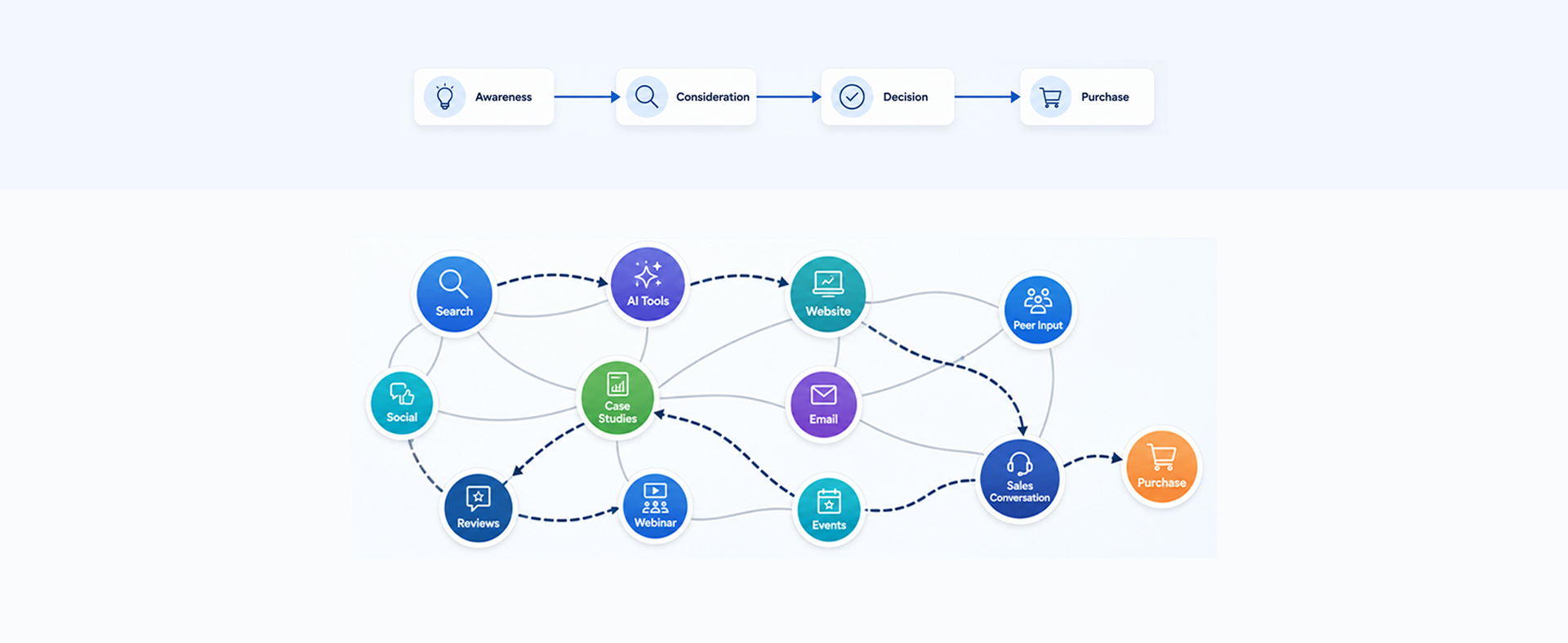
For years, B2B marketers built plans around a familiar sequence: awareness, consideration, decision, purchase. The marketing funnel.
That model is still useful for organizing messages, content, campaigns, and sales support. But it no longer reflects how most B2B buyers actually move through the buying process.
Today’s buyer journey is a series of connected moments, which by previous standards might seem random and unpredictable. For example, a prospect may hear about your brand at a trade show, visit your website later, compare you through AI search, read a LinkedIn post, attend a webinar, ignore several nurture emails, return through paid search, and finally reach out after a referral.
This new journey can take weeks or months. It may involve one decision-maker or a full team. For B2B marketers, the job is to help buyers build confidence wherever they are in the process, whether it follows the traditional funnel sequence or not.
Understanding this shift helps marketers align with how decisions are actually made today. These six realities represent some of the most significant changes shaping the modern B2B buyer journey.
1. Buyers Are Doing More Work Before They Talk to You
B2B buyers can compare vendors, read reviews, ask AI tools for recommendations, watch videos, talk with peers, and form strong opinions before contacting sales.
That creates both opportunity and risk. Buyers have more information, but they’re not always getting better guidance.
How B2B Marketers Should Respond: Create content that helps buyers evaluate options and build confidence before they contact sales.
2. Automation Needs a Strategy Behind It
Marketing automation can support segmentation, lead nurturing, follow-up, scoring, and sales alignment. But automation without strategy creates noise.
A prospect who downloads one guide may not be ready for a sales pitch. A technical buyer may need proof points, while an executive sponsor may be looking for business impact.
How B2B Marketers Should Respond: Use automation to deliver relevant information based on the buyer’s needs, not just what’s readily available and easy to send.
3. Social Media Is Part of the Research Process
In B2B marketing, social media does more than build awareness.
Buyers use social platforms to observe expertise, evaluate credibility, and notice which brands are active, helpful, and genuine. Social posts that feature employee thought leadership, customer stories, event recaps, and industry commentary all shape perception.
A buyer may never click “like” or comment. But they may still be paying attention. Every impression helps build perception and recall.
How B2B Marketers Should Respond: Treat social media as an ongoing credibility channel that supports buyer research and trust.
4. Offline Efforts Still Matter
The modern B2B journey is not purely digital. Trade shows, conferences, customer events, sales visits, printed materials, sponsorships, facility tours, and peer conversations still shape buying decisions.
The opportunity is to connect those offline moments to the larger marketing ecosystem. A trade show conversation can lead to a personalized follow-up email. A product demo can support remarketing. A conference presentation can become a blog article, video clip, social post, sales resource, and nurture email.
How B2B Marketers Should Respond: Connect offline interactions to your broader marketing strategy and follow-up process.
5. AI Is Changing How Buyers Discover and Evaluate Brands
LLM tools have become part of B2B research. Buyers are using ChatGPT, Copilot, Gemini and others to summarize options, compare vendors, generate shortlists, and ask questions they might have previously typed into Google.
That means B2B content needs to be clear, structured, useful, and credible. It should answer real buyer questions, explain what you do, show who you serve, clarify what makes your approach different, and provide evidence.
How B2B Marketers Should Respond: Publish clear, credible content that answers buyer questions and supports AI-driven discovery.
6. The Website Has to Serve Multiple Buying Moments
A B2B website can no longer function as a static brochure or a glorified ad. It needs to support discovery, education, evaluation, validation, and conversion. That requires clear positioning, strong service pages, useful thought leadership, case studies, landing pages, and content for different levels of buyer readiness.
Some visitors need education. Some need validation. Some need a reason to act now. The website should serve all three.
How B2B Marketers Should Respond: Build content and user journeys that support buyers at different stages of research, evaluation, and decision-making…and make it easy to take the next step.
We Help Marketing Teams Navigate Change
At DKY, this is where we spend much of our time: helping brands understand the moment, clarify the path forward, and build marketing that meets buyers where they actually are.
B2B buyers no longer move through one clean, predictable funnel. They gather information from websites, search engines, AI tools, social media, sales conversations, events, peers, and offline experiences.
To market accordingly, brands need a connected system built around strategy, buyer behavior, useful content, consistent messaging, smart automation, and practical measurement. DKY helps our clients do exactly that.
Key Take-Aways
What is the B2B buyer journey?
The B2B buyer journey is the process a business buyer goes through when identifying a need, researching options, evaluating vendors, building internal support, and making a purchase decision.
How is the B2B buyer journey different in 2026?
It’s no longer linear, and may not follow the traditional marketing funnel sequence. B2B buyers now use many channels at once. They may move between search, AI tools, social media, peer conversations, sales meetings, events, and website content before they are ready to contact a company.
How should B2B marketers adapt?
B2B marketers should focus on helping buyers make confident decisions. That means creating useful content, aligning channels, connecting digital and offline efforts, using automation carefully, and measuring performance across the full journey.
What role does AI play in B2B buying?
AI helps buyers summarize information, compare vendors, ask research questions, and build shortlists. B2B brands should make their content clear, credible, structured, and easy for both people and AI systems to understand.
Does marketing automation still matter?
Yes. Marketing automation helps teams deliver timely and relevant follow-up, but it needs a strategy behind it. The best automation supports buyer needs instead of simply increasing message volume.
What should a B2B website do today?
A B2B website should support discovery, education, evaluation, validation, and conversion. It should answer buyer questions, help them compare their options, communicate positioning clearly, provide proof, and make the next step easy.