
In my last post, I made the case that Voice of Customer (VoC) isn’t a survey or research project. It’s a critical discipline.
Brands that consistently outperform their competitors don’t treat customer insight as a one-time exercise before a rebrand or a strategic shift. They treat it as a structured, ongoing way of listening to inform how the business shows up every day.
That post left an obvious next question: How do you build a high-impact Voice of Customer program?
DKY has helped B2B, B2C, and non-profit clients stand up VoC initiatives that are practical, scalable, and led to positive change. Whether you’re starting from scratch or evolving a program that’s gone stale, here are three practical steps to establish a game-changing VoC program in your organization.
1. Align Your VoC Goals to What Matters
Most VoC programs that fail don’t fail because of bad data. They fail because the program doesn’t have clear objectives that address your organization’s top priorities.
It’s great to learn that you have a happy or unhappy customer. But if that information ends up living as a “huh, that’s interesting” sentiment in a staff update, nothing changes.
When building out a recent VoC program for a B2B manufacturing client, we started with their 10-year growth plan. Company leaders had already declared what matters – we simply aligned the program accordingly.
Consider your organization’s most important goals alongside these five customer experience pillars:
- Gaining a clearer understanding of customer needs and expectations. What do they actually want? What are we missing? Where are customer perceptions diverging from internal assumptions?
- Guidance for product/service improvements. Where are we falling short on quality, reliability, or delivery? What are the most critical needs or concerns that the customer cares about?
- Driving a best-in-class customer experience. How do we improve onboarding, communications, or post-sale support to build loyalty and earn referrals?
- Identifying the best opportunities for innovation leadership. Where are customers signaling emerging problems or future shifts in their needs? What should we be designing for now?
- Understanding consequential competitive forces. Have competitive offerings emerged that are eroding our business? Is our value proposition still relevant and differentiated?
Whether it be revenue growth, product advancement, or customer experience wins, your VoC program should regularly surface insights and identify opportunities to accelerate positive change.
VoC objectives should be specific enough to measure and big enough to matter. If you can’t tie a VoC finding back to a business decision, you’re collecting noise.
2. Build Your VoC Framework to Capture a Comprehensive Picture
Once your goals are set, your VoC framework determines whether you’re going to get the right data or just more data. One useful tool we’ve leveraged to guide this process is Forrester’s Customer Experience (CX) framework. It helps you consider your data needs through three distinct lenses:
Perception Metrics
How do customers feel about us?
Surfaced through interviews, brand sentiment tracking, and qualitative listening.
Interaction Metrics
How are we performing at key touchpoints?
Measured through CSAT (customer satisfaction), CES (customer effort score), and operational reviews.
Outcome Metrics
What behaviors result from the experience?
Tracked through NPS (net promoter), retention, repeat business, and advocacy.
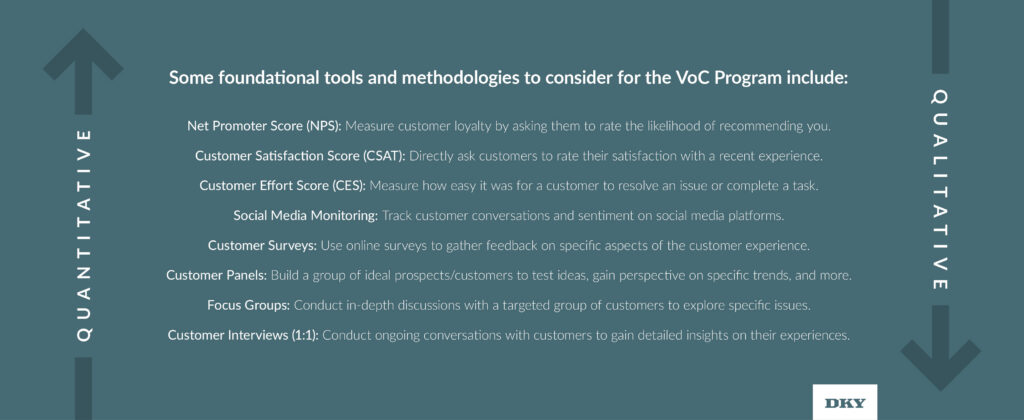
Consider each lens to design how your program should be structured. Human perceptions and behaviors are driven by both emotional and rational factors, so be sure to gather both qualitative (e.g. focus groups, interviews, comments) and quantitative (e.g. statistics, surveys, ratings) data points. Then put your qual and quant data together to paint a holistic picture.
3. Execute in Phases — Crawl, Walk, Run, Sprint
The biggest execution mistake we see is attempting to launch a fully-instrumented VoC system all at once. It’s too much, too fast, and is likely to burn out internal champions before insights ever reach a decision-maker.
A phased rollout works best:
Crawl — Foundational Learning Study (8-12 weeks)
Start by conducting 10–15 structured customer interviews, 30–45 minutes each, anchored by a discussion guide built around your goals. If budget allows, hire an outside firm or research consultant to help guide the design, conduct the interviews, and assemble the report. Having a professional, 3rd-party facilitator will deliver the most accurate, unbiased results.
Additionally, pair those interview conversations with a few complementary inputs:
- Internal “customer health check” survey to capture what your sales and service teams are hearing, and an 8-week pilot of social, web.
- Media monitoring to surface what customers are saying in public.
These three layers of data can be combined to create a baseline Voice of Customer report that surfaces a set of themes and insights, and informs an initial set of prioritized recommendations.
Walk — Baseline Tracking Launch (4-8 weeks)
Based on the Phase 1 learnings, build an on-going feedback process into your customer-facing systems. Launch an NPS (Net Promoter Score) program, build a randomized CSAT (Customer Satisfaction) survey tied to key customer touchpoints. Systematize these feedback tools, and where possible, integrate them into your sales and customer service systems for access and sharing.
Whatever processes you create, the key deliverable for the “walk” phase is a formal VoC Scorecard. Aggregate your findings, aligned to your goals, with progress tracking built in. The Scorecard becomes your team’s source of VoC truth.
Run — Continuous Deep Engagement (ongoing)
Once tracking is live, the program becomes a discipline rather than a project. Maintain CSAT, NPS and other performance tracking at every meaningful touchpoint. Establish a small cross-disciplinary team to review, iterate and refine your survey and feedback program. Each scorecard should surface new insights and directional signals to dial in the approach.
Hold quarterly business reviews with sales, marketing, and leadership to share findings, discuss causes, and workshop potential changes. This will ensure that VoC learnings become a key input for your year-round planning cycles.
A word of caution: internal VoC business reviews are an easy step to skip. Why? Because they require commitment, discipline and accountability.
But don’t let that deter you. These team reviews will separate VoC programs that drive high-impact growth from programs that just produce interesting reports.
Sprint – Fostering Relational Transformation (ongoing)
And finally, when you’re ready to hit the “sprint” stage, consider establishing a Customer Advisory Board for deeper, bi-directional input. This is VoC at its best. Imagine extended time with your best customers, in an offsite experience, workshopping the industry’s greatest challenges together.
To be successful, this step requires the most commitment and customization in your approach. We’ll outline some ideas and strategies to help you build a transformative Customer Advisory Board our 3rd installment of the Voice of Customer series.
The Bottom Line
Forrester’s research underscores why a disciplined, multi-dimensional approach like this is well worth the investment. Customer-obsessed organizations gain impressive advantages over non-customer-obsessed organizations:
- 41% faster revenue growth
- 49% faster profit growth
- 51% better customer retention
Yet in spite of these performance advantages, only 3% of companies have implemented a strategic Voice of Customer program to see how they’re actually performing with customers.
In a very direct sense Voice of Customer can be a true game-changer for your marketing team. It will help your brand win. Not because you’re out-spending your competitors, but because you’re listening better, deciding faster, and acting with more conviction.