

Marketing leaders are navigating one of the most dynamic and complex eras our profession has ever seen. Many teams have been downsized. Budgets have been reduced. AI is disrupting workflows.
Even so, the work still needs to perform. ROI isn’t an option as we look ahead to a new year of budget planning.
The good news is that maximizing your marketing investment isn’t about doing more. It’s about doing the right things consistently, creatively, and courageously. If the digital transformation era rewarded marketers who could expand, the AI age will reward those who can focus.
Here’s how modern brand builders can stay centered, strategic, and impactful in the midst of change.
Start by Recognizing the Moment: Change, Complexity & Pressure
Today’s marketers face several compounding challenges:
The proliferation of digital channels – Your audience now lives in dozens of digital ecosystems, each with its own formats, algorithms, behaviors, and metrics. Stretching budgets across too many places dilutes your impact.
The rise of AI – AI is reshaping content production, personalization, analytics and customer engagement. Teams must balance the promise of automation with the imperative to maintain authenticity and brand integrity.
Tightening budgets – As many industries enter more conservative fiscal cycles, marketers are being asked to get more done with less — a reality reflected across sectors, from manufacturing to agriculture to non-profits.
A noisier competitive landscape – Today’s brands are investing more heavily in digital and content-led marketing making it harder to stand out.
When I start to feel overwhelmed, I’ve learned that it’s best to slow down and simply break down the options.
Six Steps to Improving Your ROMI (Return On Marketing Investment)
1. Clarify your goals
This is where focus begins.
Your goals should not be dictated by trends, competitors, or internal noise. They should be rooted in your mission, business priorities, and customer needs.
DKY’s approach to Communications Plans always starts with clear goals that inform a more defined funnel, focused messaging, and a cohesive customer journey. Ask yourself:
- What are the 1–3 outcomes we must deliver this quarter, or this year?
- Which metrics matter most to the business?
- Which activities directly ladder up to those objectives?
Everything else? It’s a distraction.
2. Understand your audience deeply
In every industry the highest-performing work always ties back to real customer insights.
Whether it’s:
- Farmers choosing machinery based on reliable, trusted service partners
- B2B manufacturing buyers needing expert guidance amid growing complexity
- Ministry leaders seeking empathetic support and mission clarity
- Outdoor recreation customers looking for inspiration to fuel their passions
…your audience should be the filter through which every spending decision is made.
Insight beats assumptions. Data augments gut feel.
3. Keep what’s working
In uncertain times, marketers sometimes abandon effective programs too quickly. Resist the urge to change for change’s sake.
Double down on:
- High-performing campaigns
- Your best channels
- Your strongest audience segments
- Tactics that drive strong ROI
- Your reliable evergreen content
- Successful brand narratives or creative frameworks
Consistency builds momentum. Momentum builds efficiency.
4. Dedicate a percentage of your time/budget to innovation
High-performing, modern marketing teams preserve 10-15% of budget for disciplined experimentation.
Innovation should be:
- Aligned to your goals
- Rooted in unfulfilled customer needs
- Connected to measurable outcomes
Examples:
- Testing new AI-supported content workflows
- Running a pilot account-based marketing (ABM) campaign that unlocks pro-level capabilities of your CRM technology (e.g. Salesforce, Hubspot)
- Partnering with influencers who can introduce your solution to new customer segments
- Rolling out a new customer journey initiative for a strategic growth segment
Innovation can bring oxygen to your brand and team. Just keep it disciplined.
5. Bring structure to your spending with the PESO model
A common challenge for marketing leaders is the lack of a unified model to visualize where dollars are going, and whether those dollars align with goals. That’s where PESO comes in.
PESO is a simple but powerful way to map your entire marketing plan. Start by charting all tactics into the PESO framework to give you a single-page view of your marketing ecosystem:
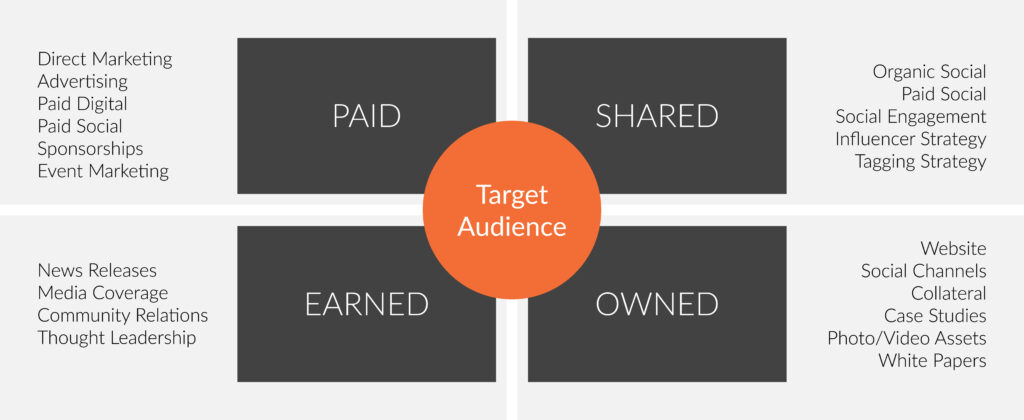
Many DKY client campaigns start by following this structure behind the scenes. The PESO model becomes a key building block for an integrated marcom plan.
Next, discuss and analyze with your team current spend against goals. Consider questions like:
Where are we overinvested?
Where are we underinvested?
Are we missing opportunities?
This assessment often reveals problems like redundancies, gaps, misaligned priorities, or underperforming spend that needs to be cut or redirected.
6. Measurement is non-negotiable
DKY strongly recommends establishing scorecards that measure brand and performance outcomes, not vanity metrics. Knowing how your investment is performing against your objectives (see step 1) is a marketer’s North Star.
Once your scorecard is built, don’t fall into the trap of perfunctory scorecard reviews. If something isn’t delivering, discuss it as a team and work the problem. Sometimes small adjustments to your marketing mix pays big dividends.
If you’re not sure about the performance of a tactic or position, try running head-to-head testing on your layout, copy positioning or call-to-action. The data will lead you to the winning combination.
Regular scorecard tracking and analysis aligned to your PESO model turns marketing into a living system — one that adapts based on performance, insight, and opportunity.
Conclusion: Modern Budget Maximization = Focus, Insight, and Discipline
Modern brand building is not about spending more. It’s about spending smarter.
The marketers who thrive in this complex, but opportunity-filled era won’t lose sight of what matters:
- Stay centered on goals
- Ground decisions in insight
- Maintain discipline around what’s working
- Invest intentionally in innovation
- Use tools like PESO and scorecards to create clarity and accountability
If you can do those things consistently, your budget, no matter its size, will go further, work harder, and deliver greater impact.